Most gutter failures in Cyprus are not discovered in summer. They are discovered at 2 a.m. during the first heavy storm of the season, when water pours down a wall instead of into a downpipe. Our dry summers hide problems for months, then a short, intense rainfall exposes all of them at once.
The good news: a failing gutter almost always shows warning signs well before it fails. Here are the five I ask homeowners to check before October.
1. Water marks or algae on the wall below the gutter
Dark streaks, peeling paint or green algae directly under the gutter line mean water is escaping, either over the edge or through a joint. Left alone, this water soaks the render, reaches the reinforcement in concrete eaves and starts the cycle of rust and spalling that is far more expensive to repair than a gutter.
Check: walk around the house and look up. Any vertical stain that starts at the gutter is a leak.
2. Sagging sections
A gutter should run in a straight line with a slight, even fall towards the outlet. A section that dips holds water, which adds weight, which makes it sag further. Standing water also breeds mosquitoes and rots fascia boards.
Usual cause: brackets spaced too far apart, or fixings pulled out of a weak fascia. Aluminium systems with hidden hangers about every 60 cm rarely sag.
3. Rust, splits or open joints
Galvanised steel gutters rust at the joints first. PVC gutters crack after years of UV exposure, and their rubber seals shrink. Any visible gap at a corner or union is a leak waiting for rain.
Seamless aluminium gutters avoid this problem: each run is formed in one piece on site, so the only joints are at corners and outlets.
4. Overflow during light rain
If water spills over the front edge even in light rain, the gutter is either blocked or undersized. Many older Cyprus houses have gutters sized for a smaller roof, before an extension or a new pergola was added.
Gutter and downpipe sizes should be calculated from the roof area and the design rainfall intensity, following the method in EN 12056-3 (gravity drainage, roof drainage). A larger 6" profile or an extra downpipe often solves overflow completely.
5. Puddles or erosion at the foundation
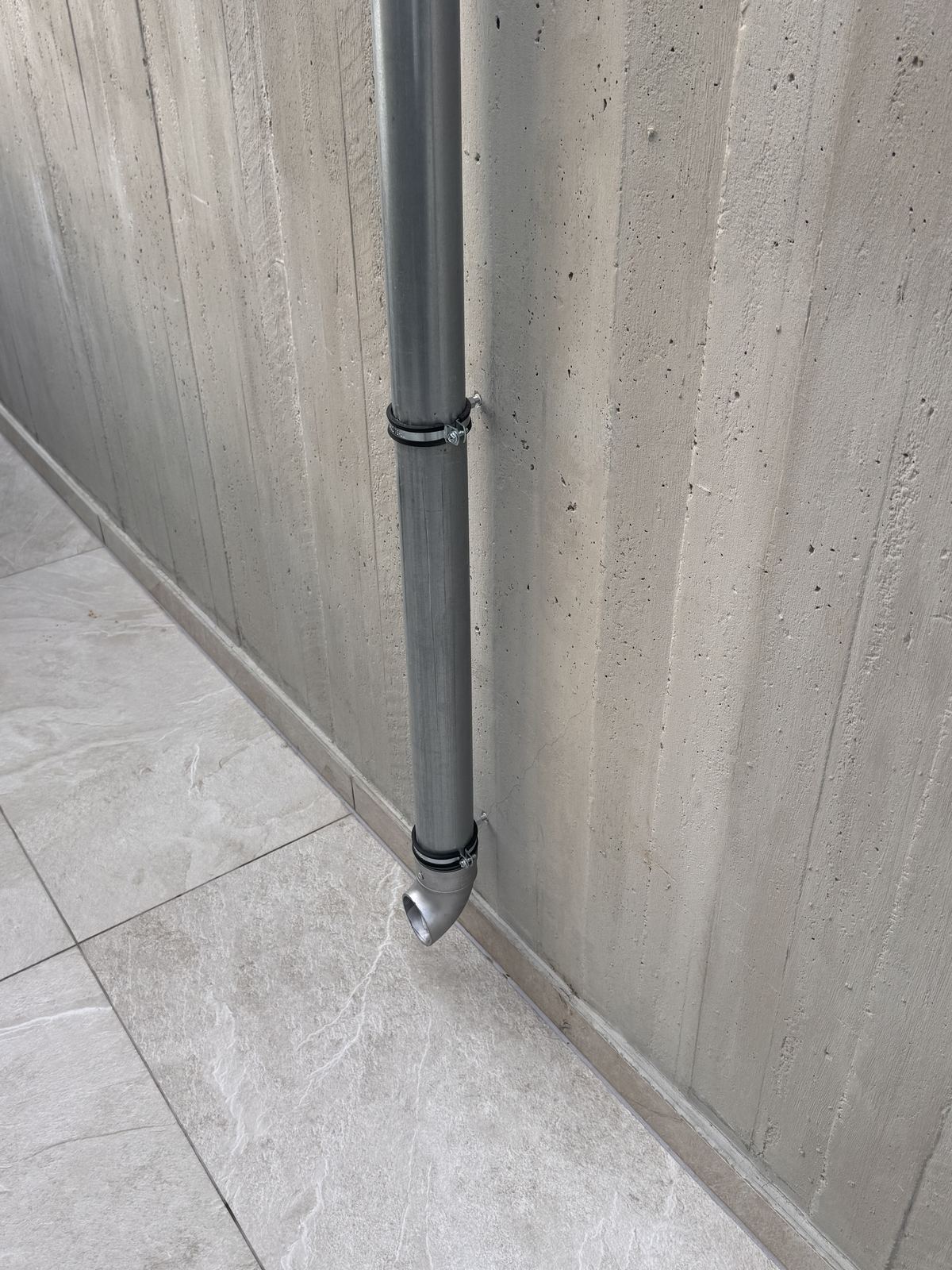
Look at the ground under each downpipe. Puddles, washed-out soil or damp patches on the base of the wall mean the water is not being taken away. Over time this can wet the foundations, damage paving and push moisture into ground-floor walls.
Fix: connect downpipes to a drain, a soakaway or a linear channel that carries water away from the building.
Repair or replace?
| Situation | Usually the right answer |
|---|---|
| Blocked but straight and sealed | Clean, add leaf guards |
| One loose bracket or leaking corner | Local repair |
| Sagging in several places | Re-fix or replace the run |
| Rusted or cracked along the length | Replace |
| Overflowing even when clean | Resize: bigger profile or extra downpipe |
What we do on a site visit
On a free site visit we measure the roof area, check falls and discharge points, and tell you whether a repair is enough. If replacement makes sense, we form seamless aluminium gutters on site, fit them with hidden hangers, connect the downpipes and water-test everything before handover.
The best time to do this is before the first storm, not after it.
Frequently asked questions
Can I just clean my gutters instead of replacing them?
Cleaning fixes blockages, not sagging, split joints or undersized gutters. If water overflows after cleaning, the system needs repair or resizing.
When is the best time to replace gutters in Cyprus?
September to early November, before the main rains. Book early: demand peaks after the first storm.
Are aluminium gutters better than PVC?
In Cyprus, yes for most homes. Aluminium does not go brittle under strong UV and holds its shape and colour far longer than PVC.
Have a project in mind?
Free site visit and written quote, island-wide.