A delivery note says what concrete was ordered. It does not prove what arrived. The only way to know is to test it, and to test it properly.
I have spent most of my career around concrete plants and laboratories in Cyprus. The same lesson repeats on every site: problems that appear years later, such as cracks, dusting floors or rusting reinforcement, usually started on the day of the pour, when nobody checked the mix.
What gets tested, and why
On site, when the truck arrives
| Test | Standard | What it tells you |
|---|---|---|
| Slump (or flow) | EN 12350-2 / -5 | Workability. A slump far above the specification often means extra water was added. |
| Temperature | EN 206 limits | Hot concrete in a Cyprus summer stiffens fast and cracks more. |
| Air content | EN 12350-7 | Needed when air-entrained concrete is specified. |
| Sampling for cubes | EN 12350-1 | A representative sample taken from the middle of the discharge. |
In the lab
Cubes (150 mm) are made on site, cured in water at a controlled temperature and crushed at 7 and 28 days following EN 12390-3. The 28-day result is what EN 206 uses to judge whether the concrete meets its strength class, for example C25/30 or C30/37.
The water problem
The most common site mistake is adding water to make the concrete easier to place. It feels harmless. It is not.
Strength and durability depend mainly on the water/cement ratio. More water means more pores, lower strength, more shrinkage and an easier path for chlorides and carbonation to reach the steel. A few extra litres per cubic metre can move a mix from one strength class to the one below.
If concrete is too stiff to place, the right fix is a superplasticiser dosed by the supplier, not a hose.
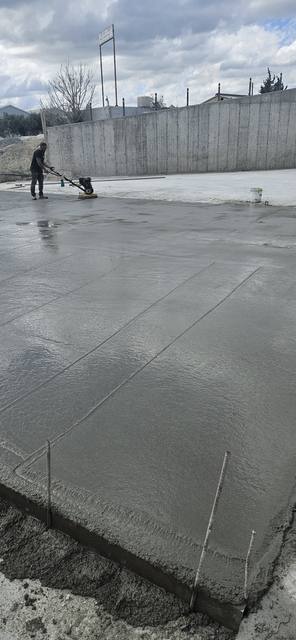
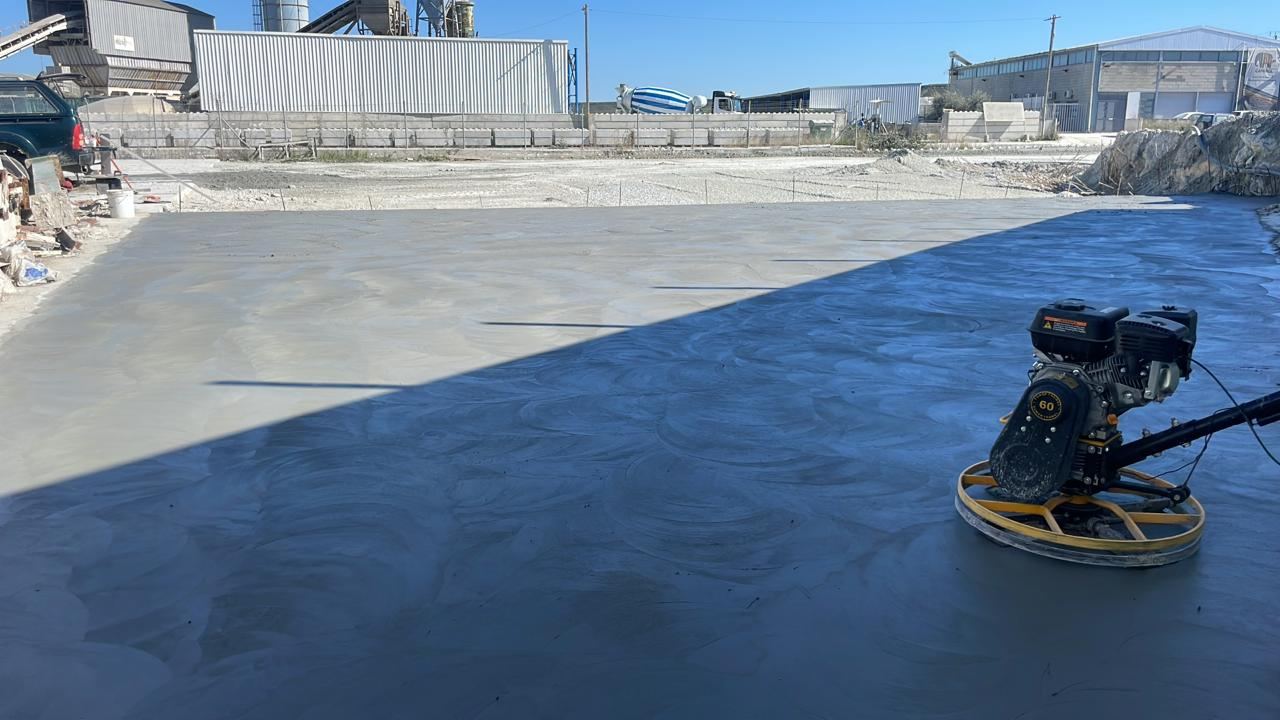
Floors and screeds are tested too
Self-levelling compounds and screeds are designated under EN 13813, for example CT-C25-F5 (compressive 25 MPa, flexural 5 MPa). Before a floor finish goes down we also check:
- Flow of each batch, so the pour levels correctly
- Surface tensile strength, so the finish bonds and does not delaminate
- Moisture content before resin, wood or vinyl is laid
A beautiful resin floor laid on a wet screed will blister. A moisture test takes minutes.
What testing gives the client
- Proof. A test record shows the concrete or screed met the specification.
- Early warning. A low 7-day result lets you act before more floors are built on top.
- Fewer disputes. When something goes wrong, data settles the argument faster than opinions.
How we work at CONCREX
Our own lab lets us check materials before and during the job, not after a problem appears. For larger projects we agree a sampling plan with the engineer at the start, so everyone knows what will be tested and when.
If you are planning a project and want to know what testing it needs, ask us during the free site visit.
Frequently asked questions
What is the difference between C25/30 and C30/37?
The numbers are the characteristic compressive strength in MPa measured on cylinders and on 150 mm cubes at 28 days. C30/37 is a stronger class, typically needed for more demanding structures or exposure conditions.
Why are cubes tested at 28 days?
EN 206 defines strength classes at 28 days. Early tests at 7 days are useful as an indication, but conformity is judged on the 28-day result.
Can water be added to concrete on site?
Not without control. Adding water raises the water/cement ratio, which lowers strength and durability. If workability must change, it should be done with an admixture by the supplier.
Have a project in mind?
Free site visit and written quote, island-wide.