×

Three Limassol buildings made the news in 2026 for the wrong reason: a partial collapse in Yermasoyia in April that cost two lives, a balcony collapse on a seven-storey block in Kapsalos in June, and another balcony collapse in September that forced 56 flats to be evacuated. In each case the warning signs were there for years.
This article explains, in plain terms, why so many Cypriot buildings are at risk, which signs an owner or management committee should never ignore, and how a building is properly assessed and repaired. It is written by a civil engineer, not a lawyer: for your own building, always appoint a civil engineer registered with ETEK.
1. Why this matters in Cyprus
Cyprus sits on the Cyprus Arc, where the African plate meets the Anatolian plate. The island has had damaging earthquakes in living memory, most notably Paphos 1953 (about 40 dead) and the Paphos earthquakes of 1995 and 1996. Offshore events, such as the January 2022 earthquake west of Paphos, are felt island-wide.
The building stock is the bigger issue. Seismic design rules came in stages:
| Year | What changed |
|---|---|
| 1992–1994 | First Cyprus Seismic Code, applied to new buildings from 1994 |
| 1999–2000 | Supervision of construction by an engineer becomes mandatory |
| 2012 | Eurocodes become mandatory, including Eurocode 2 (concrete) and Eurocode 8 (earthquakes) |
According to Statistical Service data quoted by ETEK, about half of all homes in Cyprus were built before 1994, so before any seismic code applied, and more than half before supervision became compulsory. Many of these buildings were well built. Many were not, and almost none have had a structural check since.
2. What actually goes wrong
Corroding reinforcement
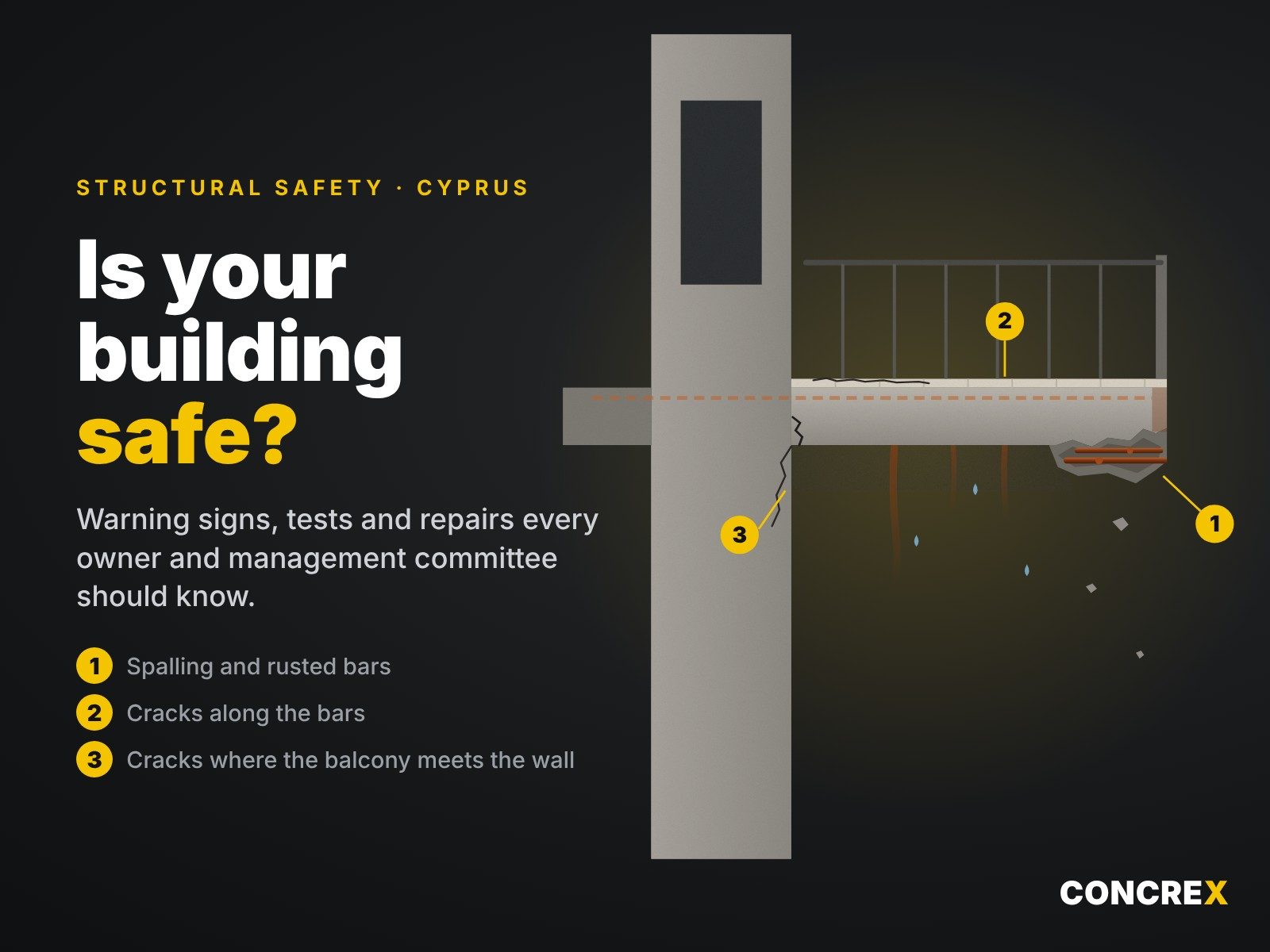
Concrete protects steel bars by being alkaline. Over the years carbon dioxide from the air (carbonation) and, near the sea, salt (chlorides) work their way into the concrete. When they reach the bars, the steel rusts, expands and cracks the concrete off. This is the classic spalling you see on old balconies, beam soffits and columns at ground level. Thin cover, porous concrete and water dripping from balconies or roofs speed it up dramatically.
Weak original concrete
In the 1970s and 1980s much concrete was mixed on site or ordered by "strength and slump" only, often with water added at the truck. The result can be concrete far below its design strength, with high porosity, which carbonates faster and protects the steel worse. We explain what a proper specification looks like in our article on EN 206.
Balconies
A cantilevered balcony holds up only because of the top reinforcement anchored into the slab behind it. That steel sits right under the tiles, where water collects. When it corrodes, a balcony can fail with little warning. That is why balconies feature so often in Cypriot collapse reports.
Alterations nobody checked
Removing a wall or column for an open-plan shop, enclosing pilotis, adding a floor or a heavy roof tank, cutting openings in slabs: any of these can change how a building carries load and how it behaves in an earthquake. Ground-floor shops in older blocks with open pilotis ("soft storeys") are a known weak point in earthquakes worldwide.
No maintenance
ETEK puts it simply: a 20–25-year-old building that has been maintained shows very little damage, while a 40–50-year-old building that has never been maintained can be in serious trouble. In jointly owned blocks, maintenance often stalls because there is no reserve fund or working management committee.
3. Warning signs you should never ignore
- Rust stains or brown streaks on concrete, especially under balconies and on columns.
- Cracks that run along a beam, column or slab edge, following the line of the bars.
- Concrete falling off and exposed, rusted reinforcement.
- Diagonal or X-shaped cracks in columns, beams or walls, or cracks that keep growing.
- Balconies that sag, slope outwards, or have cracks where they meet the building.
- Persistent water on roofs and balconies, leaking joints and damp patches on ceilings.
- Doors and windows that suddenly stick, or floors that are no longer level.
None of these means a building is about to fall. Each one means a civil engineer should look at it, and some need action straight away: if concrete is falling or a balcony is moving, keep people away from it and call an engineer the same day.
4. How a building is properly assessed
A structural assessment is engineering work, not a visual guess. ETEK's guidance describes three levels:
- Rapid visual screening: an engineer inspects the building on a standard form and decides whether more is needed.
- Approximate assessment: drawings are studied and a limited number of tests are taken.
- Full assessment to CYS EN 1998-3 (Eurocode 8, Part 3), the European standard for assessing and retrofitting existing buildings.
The tests themselves are standard practice in Europe:
| Test | What it tells you |
|---|---|
| Concrete cores (EN 12504-1, assessed to EN 13791) | The real in-place strength of the concrete |
| Rebound hammer (EN 12504-2) | A quick comparison of surface hardness across many points |
| Carbonation depth (phenolphthalein, EN 14630) | How deep the protective alkalinity has been lost, versus the bar cover |
| Cover meter / rebar scanning | Where the bars are, their size and how much concrete covers them |
| Chloride content | Whether salt has reached the steel (important near the coast) |
The engineer then decides on the repair: from local concrete repair to EN 1504 (remove damaged concrete, clean and protect the steel, rebuild with repair mortar, protect the surface), up to strengthening with jackets, steel or composite wraps, or new walls.
5. What the law says in 2026
At the time of writing, Cyprus has no mandatory periodic inspection of buildings. Municipalities can declare a building dangerous, and around 1,300 buildings were on those lists nationally in April 2026. Amendments to the Streets and Buildings Regulation Law that would give authorities stronger powers (fines, rental bans, utility cut-offs) were before the House Interior Committee in autumn 2026. A long-pending bill on jointly owned buildings would make reserve funds and management committees work properly.
ETEK and the property developers' association have both called for a "building MOT", a compulsory inspection every few years, and for grants similar to the energy-upgrade schemes. These remain proposals for now. Owners should not wait for a law to check their own building.
6. New buildings: getting it right from day one
For new construction, safety is decided long before the building is finished:
- Specify concrete properly: strength class and exposure class (for example XC4 or XS1 near the sea), maximum water/cement ratio and minimum cover, as Eurocode 2 and EN 206 require.
- Never add water at the truck; use admixtures instead.
- Test what arrives: cubes from the actual deliveries, tested by a laboratory, not just the delivery note.
- Cure the concrete: in the Cyprus summer, a slab that dries out in the first days loses durability for life. Our curing monitoring and fogging article explains how we control this.
- Waterproof and drain roofs and balconies properly; water is what drives corrosion.
7. How CONCREX can help
CONCREX is a concrete and construction company run by a civil engineer with a long career in Cyprus ready-mix production, mix design and testing. We supply and place concrete to specification, carry out concrete quality control with our own laboratory, and carry out concrete repair, waterproofing and renovation works.
For an existing building, we work with you and your structural engineer: the testing (cores, carbonation, cover), the repair to EN 1504, and the waterproofing that stops the damage coming back. If you are worried about a balcony, a crack or a block you manage, ask us for a site visit.
References: ETEK, seismic assessment of existing buildings (2026); Statistical Service of Cyprus, Census 2021, as quoted by ETEK; Cyprus Mail, 15 Apr, 3 Sep and 25 Sep 2026; Politis, 26 Jun, 11 Aug and 1 Sep 2026; CYS EN 1998-1 National Annex (2019); EN 1998-3, EN 1504, EN 12504-1/-2, EN 13791, EN 14630. General guidance only, not a substitute for an engineer's inspection.
Frequently asked questions
Is there a mandatory building inspection in Cyprus?
Not at the time of writing (November 2026). Municipalities can declare a building dangerous, and bills giving authorities stronger powers were before the House Interior Committee in autumn 2026. A compulsory periodic inspection ("building MOT") has been proposed by ETEK but is not law.
How do I know if my balcony is dangerous?
Warning signs are rust stains or cracks underneath, concrete falling off, exposed rusted bars, a slab that sags or slopes outwards, and cracks where the balcony meets the building. If concrete is falling or the balcony moves, keep people off it and call a civil engineer the same day.
Who should assess my building?
A civil engineer registered with ETEK. The engineer decides whether a visual inspection is enough or whether drawings, tests and a full assessment to CYS EN 1998-3 are needed. A testing laboratory or contractor supports the engineer with cores, carbonation and cover measurements and with the repair.
Can spalling concrete be repaired, or does it need demolition?
Most spalling is repairable. A proper repair to EN 1504 removes the damaged concrete, cleans and protects the steel, rebuilds the section with repair mortar and protects the surface. Where the steel has lost too much section or the structure is weak overall, the engineer will specify strengthening instead.
Have a project in mind?
Free site visit and written quote, island-wide.