×

Epoxy is an excellent resin indoors, but outdoors in Cyprus it fails in two ways. Sunlight breaks down its aromatic structure, and its rigidity cannot follow the daily heating and cooling of a slab. The result is the floor everyone has seen: yellowed, chalky, dull, and eventually cracked or debonded. For outdoor floors, terraces, pool surrounds and resin-bound stone, we specify UV-stable (aliphatic) polyurethane instead, because it keeps its colour in the sun and stays flexible as the surface moves.
1. The chemistry: why sunlight attacks epoxy
Most floor epoxies are built on bisphenol A, a molecule with benzene (aromatic) rings. Those rings absorb ultraviolet light strongly, around 300 nm, which is exactly the UV-B band that reaches the ground on a Cyprus summer day.
The absorbed energy starts photo-oxidation at the surface:
- UV light breaks bonds next to the aromatic rings and creates free radicals.
- Oxygen reacts with them and forms carbonyl and, later, carboxylic acid groups. These new groups absorb visible light, so the resin turns yellow, then brown.
- The oxidised skin becomes brittle and erodes into a fine powder (chalking), and the gloss disappears.
In a published laboratory study, an unprotected epoxy was clearly yellow after 500 hours of UV and lost about 30% of its tensile strength after 800 hours. UV absorbers cut the loss to about 11% but did not stop it. A floor in the open in Cyprus is exposed to the same UV-B band every summer day, for years.
Polyurethane is made from a polyol and an isocyanate, and the isocyanate decides how it ages in the sun:
- Aromatic polyurethanes (MDI, TDI) also contain benzene rings and also yellow in sunlight. Their colour can shift in as little as two weeks of exposure.
- Aliphatic polyurethanes (HDI, IPDI) have no aromatic rings in the backbone. They absorb very little UV, so they keep their colour and gloss for years.
This is why "polyurethane" alone is not enough on a specification. Outdoors, the resin must be aliphatic, or carry an aliphatic UV-stable topcoat.
2. The mechanics: a floor that moves every day
An outdoor slab in Cyprus heats in the afternoon sun and cools at night, every day for months. Concrete and resin expand by different amounts as they do: roughly 10–12 × 10⁻⁶ per °C for concrete and several times more for unfilled epoxy (approximate textbook values; the exact figure depends on the product and its filler).
The resin layer therefore has to stretch and shrink against a base that barely moves. What decides whether it survives is how far it can stretch before it breaks:
| Property | Epoxy | Polyurethane (cast elastomer) |
|---|---|---|
| Elongation at break | 4.5% | 580% |
| Tensile strength | 67 MPa | 39 MPa |
| Glass transition | 120 °C | −50 °C |
These are generic material values, not those of a specific floor product. Epoxy is stronger but stretches only a few percent, so repeated thermal strain concentrates at cracks, joints and edges until the resin cracks or lets go of the base. Polyurethane is weaker in pure tension but far more elastic: it follows the movement and bridges hairline cracks in the base, while UV ageing makes epoxy even more brittle over time.
3. Resin-bound stone: where the choice matters most
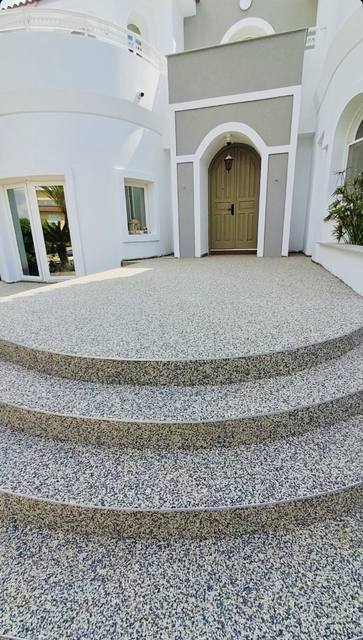
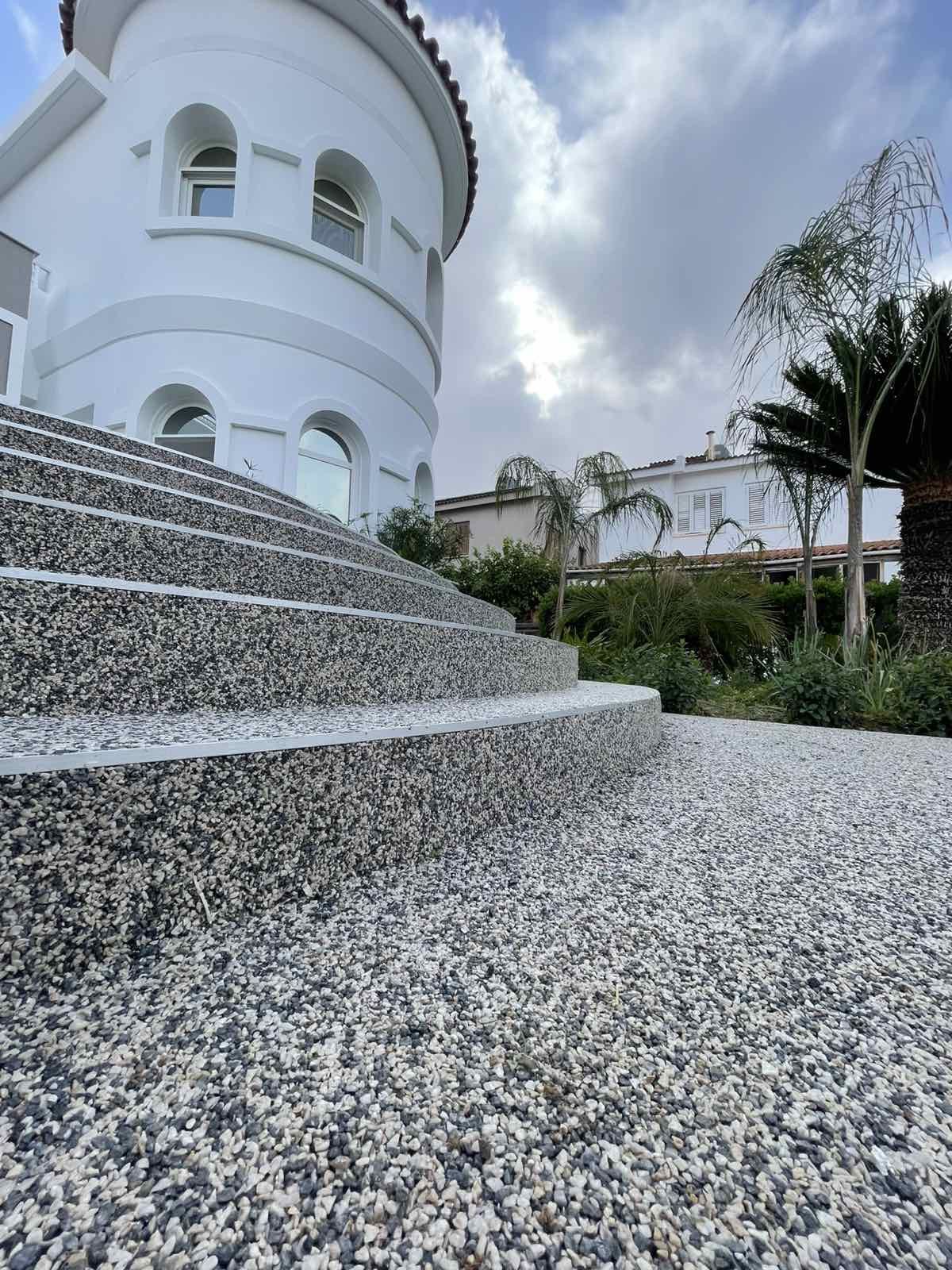
In a resin-bound surface such as VUBA stone carpet, the resin is only a thin film wrapped around each stone, holding the stones together at their contact points. The open voids between them are what make the surface permeable. That thin film is fully exposed to light and air, so any weakness shows quickly:
- Colour. A non-UV-stable binder can darken in as little as two weeks of sun, and areas under parked cars or bins end up a different shade from the rest.
- Brittleness. A binder that is strong but stiff turns brittle and cracks. When contact points crack, stones start to come loose ("ravelling").
- Water. Because water drains through the surface, the binder sees wet–dry cycles as well as heat–cold cycles. A flexible, UV-stable polyurethane keeps the bond intact through both.
The UK resin-surfacing trade says the same: cheaper aromatic systems yellow, discolour and are liable to cracking, and the main cause of failures is mis-sold products. This is why we build outdoor resin-bound surfaces with a UV-stable polyurethane binder and BBA-certified materials. See also how to clean a resin-bound driveway.
4. Side by side
| Epoxy | Aromatic PU | Aliphatic PU | |
|---|---|---|---|
| UV / colour stability | Poor: yellows, chalks | Poor: yellows, darkens | Very good |
| Flexibility | Low (a few %) | High | High |
| Thermal movement, crack bridging | Poor | Good | Good |
| Abrasion and chemical resistance | Very good | Good | Good |
| Cost | Lower | Lower | Higher, cures slower |
| Best place | Indoors | Under a UV-stable topcoat | Outdoors, in full sun |
5. Where epoxy is still the right choice
This is not an argument against epoxy. Indoors, away from sunlight and large temperature swings, its hardness, adhesion and chemical resistance make it an excellent choice for garages, workshops, warehouses and plant rooms (see garage and workshop floors). A common professional build-up is an epoxy primer or base coat for adhesion, finished with an aliphatic polyurethane topcoat wherever light reaches the floor.
How CONCREX specifies an outdoor resin floor:
- Check the base: strength, moisture, cracks and falls.
- Choose the resin by exposure: aliphatic, UV-stable polyurethane for anything in sun.
- Detail joints and edges to allow thermal movement.
- Check slip resistance for wet areas with the EN 13036-4 pendulum test.
- Hand over care instructions and a record of the materials used.
Sources: The Effects of UV Light on the Chemical and Mechanical Properties of a Transparent Epoxy-Diamine System (PMC5459211) · Aromatic vs aliphatic isocyanates in coatings (Pflaumer) · UV-stable vs non-UV resin (Resin Bonded Aggregates) · Epoxy vs AU polyurethane (MakeItFrom) · A Guide to Resin Surfacing (Pavingexpert / Star Uretech).
Frequently asked questions
Why does epoxy turn yellow outdoors?
Its bisphenol A structure absorbs UV light around 300 nm. The energy oxidises the surface and forms carbonyl groups that absorb visible light, so the resin yellows, chalks and loses strength.
Is all polyurethane UV-stable?
No. Aromatic polyurethanes (MDI, TDI) also yellow in sunlight. Only aliphatic polyurethanes (HDI, IPDI) keep their colour outdoors.
Can I put epoxy outside if I add a topcoat?
Yes, if the epoxy is fully covered by a UV-stable aliphatic polyurethane topcoat that is maintained. The topcoat must be renewed before it wears through.
Why does flexibility matter on a terrace?
The slab heats and cools every day. A resin that stretches only a few percent cracks or debonds under that repeated movement; a flexible polyurethane follows it.
Which resin do you use for VUBA resin-bound stone?
A UV-stable polyurethane binder, so the stones keep their natural colour and the surface stays permeable and crack-free.
Have a project in mind?
Free site visit and written quote, island-wide.