Every driveway in Cyprus has to survive the same three things: 40 °C sun for months, sudden heavy rain in winter, and a car turning its wheels on it every day. The three surfaces I get asked about most handle these very differently.
Here is an honest engineering comparison of resin-bound stone (such as VUBA stone carpet), plain concrete and interlocking concrete pavers, so you can choose with your eyes open.
The short answer
| Resin-bound stone | Plain concrete | Interlocking pavers | |
|---|---|---|---|
| Upfront cost | Medium to high | Lowest | Medium |
| Can go over existing concrete | Yes, if sound | Only as a new overlay slab | No, needs a new sub-base |
| Rainwater | Permeable, no puddles | Runs off, needs falls and channels | Mostly runs off, some through joints |
| Cracking | Follows cracks in a bad base | Will crack unless jointed and cured well | Does not crack, but blocks can sink |
| Weeds | None through a sound surface | Only at cracks and joints | Yes, in the sand joints |
| Surface heat | Depends on colour; light blends stay cooler | Light grey, moderate | Depends on colour |
| Look | Seamless natural stone, 32 colours | Plain, can be stamped or exposed | Pattern of blocks |
| Repairs | Local patch possible | Patches always show | Lift and relay blocks |
1. Plain concrete: cheapest, if it is done right
A reinforced concrete slab is the most common driveway in Cyprus, and it can last decades. The problem is that most driveway slabs are poured fast, in summer, with water added on site and no curing. The result is the familiar pattern of random cracks within the first year.
If you choose concrete, insist on:
- A compacted sub-base and a slab of about 12–15 cm for cars, with mesh in the right position (not lying on the ground).
- A proper mix, at least C25/30, and no extra water on site. I explain why in Why We Test Every Mix.
- Control joints cut early, roughly every 3–4 m, so the slab cracks where you want it to.
- Curing for at least 7 days. In a Cyprus summer this is not optional; see why new concrete cracks in summer.
- A fall of about 1.5–2% away from the house, towards a channel or the garden.
Best for: tight budgets, heavy vehicles, and as the base for a resin-bound finish later.
2. Interlocking pavers: flexible, but high maintenance
Concrete block pavers on a sand bed do not crack as a slab does, because each block can move a little. That flexibility is also their weakness. If the sub-base is not compacted properly, wheel tracks and dips appear, especially where cars turn. Sand washes out of the joints in winter storms, and weeds and ants move in.
Pavers need edge restraints, a well-compacted granular sub-base of about 15–25 cm for cars, and re-sanding of joints every few years. Done well, they are durable and easy to lift for services underneath.
Best for: large areas where a patterned look is wanted and some maintenance is acceptable.
3. Resin-bound stone: seamless, permeable and low maintenance
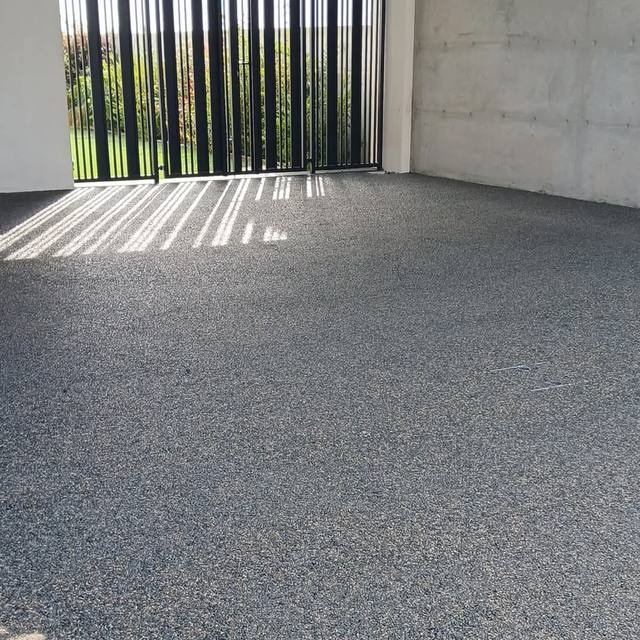
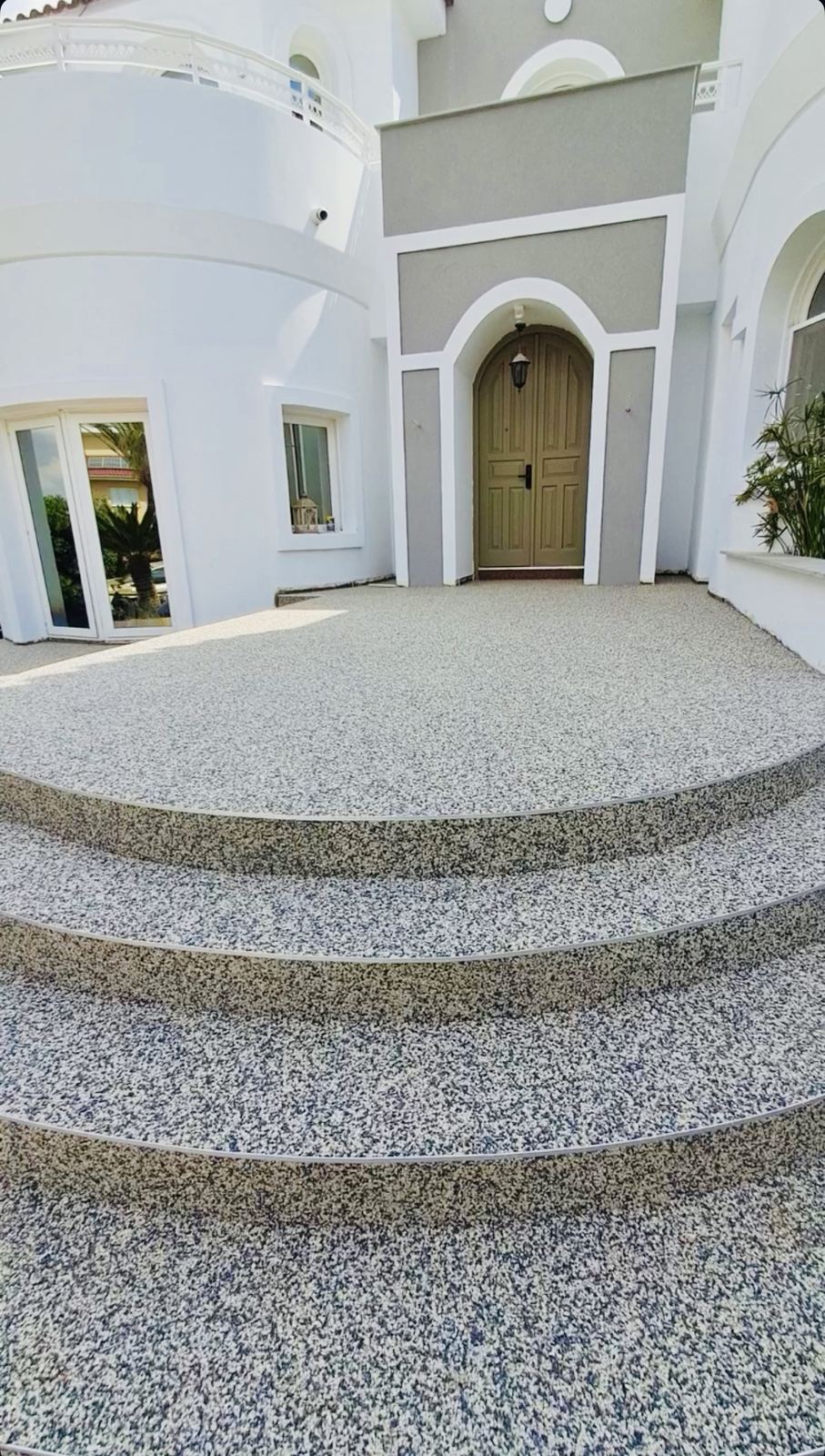
Resin-bound stone is natural aggregate mixed with a UV-stable resin and trowelled into a smooth, continuous surface, typically 15–18 mm thick for driveways. Because the stones are bound with gaps between them, rainwater drains straight through. No puddles, no ice, no loose gravel.
Its big advantage in Cyprus is that it can often go over an existing concrete driveway. You keep the slab you already paid for, repair its cracks, and get a new surface in one or two days. Its limitation is the same thing: resin-bound stone is only as good as the base. A slab that is still moving will crack the finish too.
The colour matters for heat. Light, mixed blends stay noticeably cooler underfoot than dark ones, which is why we use them around pools (see best pool surround surfaces).
Best for: renovating a sound but tired concrete driveway, entrances and paths where looks and drainage matter.
What really decides the lifespan
After many years on sites, my experience is that the surface is rarely what fails first. The base and the drainage are. Whatever you choose:
- Check the ground and the existing slab before you pick a finish.
- Give the water somewhere to go: falls, a linear channel at the gate or garage, or a soakaway.
- Specify thickness for cars, not for people. A path build-up under a driveway will fail.
- Ask what is included in the quote: base, edging, drainage and joints.
Our recommendation
| Your situation | Usually the best choice |
|---|---|
| New build, tight budget | Well-made concrete with joints; resin-bound later if wanted |
| Old concrete, sound but cracked and stained | Repair cracks, resin-bound stone overlay |
| Old slab breaking up or sinking | New base, then concrete or resin-bound |
| Driveway that floods at the gate | Correct falls and add a channel, whatever the finish |
| Large plot, patterned look, services underneath | Interlocking pavers on a proper sub-base |
At CONCREX we install VUBA resin-bound stone carpet, repair concrete, and design the drainage around it. On a free site visit I check the base and tell you honestly which option makes sense for your driveway, even if it is not the one we sell.
Keeping a resin-bound driveway looking new is simple; see our aftercare guide.
Frequently asked questions
Which driveway is cheapest in Cyprus?
Plain concrete usually has the lowest upfront cost. Over the life of the driveway the gap narrows, because concrete cracks and stains are hard to repair invisibly and pavers need re-levelling and weeding.
Can resin-bound stone go over my old concrete driveway?
Often yes, if the concrete is sound, stable and drains. Cracks are repaired first. A broken or moving slab needs a new base.
Do I need planning permission for a new driveway?
Usually not for resurfacing inside your own plot, but check with your local authority if you change levels, the pavement crossing or drainage onto the road.
Have a project in mind?
Free site visit and written quote, island-wide.